

BRITISH COLUMBIA – Majority women-owned businesses in Canada are on the rise.
Majority women-owned businesses accounted for 20.6% of all private sector businesses in Canada in the first quarter of 2026, according to Statistics Canada, and are most frequently found in professional, scientific and technical services, and health care and social assistance.
The Statistics Canada Labour Force Survey states that 80.1% of core-aged women (25 to 54 years old) were employed in Canada in January this year, and from the beginning of January to early February, the Canadian Survey on Business Conditions to collect information on the environment in which businesses are currently operating and on their future expectations.
The article explores results from the survey for majority women-owned private sector businesses, focusing on their expectations related to labour, the supply chain, outsourced work and debt in the first quarter of 2026. Majority ownership is defined at 51% or more and was self-reported for private sector businesses only.
In the first quarter of 2026, majority women-owned businesses employed greater proportions of women in all positions when compared with all private sector businesses. Additionally, majority women-owned businesses reported lower ability to take on more debt compared with all private sector businesses. In the first quarter of 2026, the proportion of majority women-owned businesses that sought alternative suppliers outside the United States was similar to that of all private sector businesses.
Finally, majority women-owned businesses were less likely than all private sector businesses to report a decrease in revenue compared with the previous year.
 In the first quarter of 2026, the average proportion of women in senior management positions within majority women-owned businesses was 74.8%, almost double the proportion within all private sector businesses (38.8%). Senior management may include owners or operators for smaller businesses, and titles such as executive director, chief executive officer, chief financial officer and chief operating officer for larger businesses.
Majority women-owned businesses reported a higher average proportion of women in other management positions (68.1%) compared with all private sector businesses (45.2%). Furthermore, the average proportion of women in all other positions within majority women-owned businesses (68.1%) was higher than that for all private sector businesses (43.7%). For all three employment categories, the proportion of women employed was significantly higher in majority women-owned businesses compared with all private sector businesses.
In the first quarter of 2026, 31.5% of majority women-owned businesses anticipate obstacles related to labour, down 1.6% compared with the same quarter a year ago. Comparatively, in the first quarter of 2026, 32.9% of all private sector businesses expect labour-related obstacles which edged down 2.8% from the previous year. The proportions of businesses expecting labour force shortages, recruiting and retaining skilled employees to be obstacles over the next three months were similar for majority women-owned businesses and all private sector businesses.
Compared with all private sector businesses (59.6%), majority women-owned businesses (60.6%) are about as likely to expect cost-related obstacles over the next three months. Cost-related obstacles include costs of inputs and costs in real estate, leasing or property tax and those specific breakdowns differ among majority women-owned businesses compared with all private sector businesses.
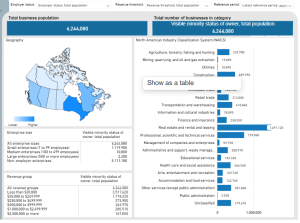
Business Ownership Diversity Dashboard. Click on image to see interactive dashboard.
While a lower proportion of majority women-owned businesses (23.3%) expect costs of inputs to be an obstacle compared with all private sector businesses (25.0%), majority women-owned businesses are more likely (24.8%) to report costs in real estate, leasing or property tax as an obstacle compared with all private sector businesses (21.9%).
Majority women-owned businesses (8.4%) are about as likely to plan to expand the business without increasing the physical space over the next 12 months compared with all private sector businesses (8.6%). Similarly, majority women-owned businesses (8.6%) are more likely to plan to restructure the business over the next 12 months compared with all private sector businesses (7.4%). Meanwhile, majority women-owned businesses (5.4%) are slightly less likely to plan to expand the current location of the business over the next 12 months compared with all private sector businesses (6.4%).
Majority women-owned businesses (17.0%) were about as likely to have changed their marketing practices to promote Canadian products over the last 12 months compared with all private sector businesses (16.6%), and both were equally likely to experience an increase in sales of such products over the last 12 months (13.2%, 12.7%).
In the first quarter of 2026, the proportion of majority women-owned businesses (10.4%) that are planning to apply for debt financing over the next three months was similar compared with the proportion of all private sector businesses (10.4%).
Majority women-owned businesses are more likely to use debt financing for refinancing of existing debt (42.8%) and current expenditure (28.0%) while all private sector businesses are more likely to use debt financing for refinancing of existing debt (38.2%) and business expansion (31.0%).
Among businesses that do not plan to apply for debt financing, one-quarter of majority women-owned businesses (25.0%) reported being unable to take on more debt compared with 23.1% of all private sector businesses.
A similar proportion of majority women-owned businesses (31.2%) experienced an increase in revenue in 2025 compared with 2024 compared with 31.9% of all private sector businesses. Majority women-owned businesses were more likely (40.6%) to have no change in revenue compared with all private sector businesses (35.9%), while majority women-owned businesses were less likely (28.3%) to have a decrease in revenue compared with 32.2% of all private sector businesses.
Business Examiner