
 Advertorial
BRITISH COLUMBIA– The demand for better ventilation, rising energy costs, and increasingly compact homes are pushing builders to look for smarter solutions. Ductless ERVs have emerged as a practical solution that is simple to install, efficient to operate, and adaptable for both new builds and retrofits.
Build Smarter with Ductless Ventilation
Across British Columbia, construction projects are adapting to evolving energy codes. With the Province’s Step Code raising efficiency requirements, ERVs are becoming a key component in residential and multi-unit projects.
When selecting a ventilation system for compact or modular builds, you need something that’s easy to install, efficient to operate, and compact enough to fit into tight spaces without compromising performance. That’s where Holtop’s ductless ERV comes in.
It delivers flexibility on-site with a compact form measuring just 660mm (26 inches) wide, 455mm (18 inches) high, and 155mm (6 inches) deep. This allows it to fit easily into laneway homes, condos, or small multi-unit developments. Being ductless eliminates the need for bulky ductwork and drop ceilings, simplifying layout planning and reducing both labour and material costs. This helps keep construction timelines efficient, particularly for prefab and space-conscious designs.
With a plug-and-play setup, the system requires no duct balancing or complex integration, minimizing installation time and disruption. It provides up to 88 CFM (150 m³/h) of balanced airflow, which is more than 150% greater than many small ductless models. This means better air exchange, improved comfort, and fewer compromises in challenging build environments.
CSA certified ERV Canada
Holtop’s ERV is CSA certified for Canada and the U.S., listed under Certificate No. 80161167. The unit meets recognized safety and performance standards, including:
- CAN/CSA-C22.2 No. 113-18 – Electrical safety and construction for fans and ventilators
- UL 1815 (5th Edition) – U.S. standard for non-ducted heat recovery ventilators
- CSA Class 3812-01 & 3812-81 – Fan and blower certification for Canada and the U.S.
- ISO/IEC 17065 – Ongoing third-party audit and compliance
These certifications offer more than just regulatory peace of mind. It’s ready for permitting and inspections in both Canada and the U.S. without additional engineering review, reducing the risk of delays or code compliance issues. For anyone evaluating long-term system performance, it reinforces that the system has undergone independent testing to meet strict safety, performance, and quality benchmarks. This helps ensure long-term reliability and confidence in everyday use.

Health and Energy Benefits of Balanced Ventilation
As summer approaches, BC homeowners face poor air quality from seasonal allergens, wildfire smoke, and humidity. In cities like Vancouver, many homes are older and not equipped with proper ventilation. Opening windows isn’t always an option.
According to Health Canada, Canadians spend up to 90% of their time indoors, where air can be more polluted than outside. Poor indoor air contributes to sleep disruption, fatigue, and long-term respiratory issues. The EPA notes that indoor pollutants can exceed outdoor levels by more than 100 times (https://www.epa.gov/report-environment/indoor-air-quality).
In any well-performing ventilation system, filtration matters. You need a unit that doesn’t just move air but actively improves it. Holtop’s ductless ERV brings in fresh air while filtering out smoke, pollen, and dust with impressive efficiency.
It captures up to 99% of PM2.5, which are some of the smallest and most harmful airborne particles, providing strong protection during wildfire season or allergy spikes. Its multi-stage filtration includes a pre-filter to trap larger particles, a HEPA-like filter for fine particulates, and an activated carbon layer to reduce odors, VOCs, and low-level gases. The result is cleaner, healthier indoor air, which supports better sleep, respiratory health, and overall well-being, especially for those sensitive to seasonal or urban pollutants.
Its high-efficiency DC motor keeps the unit quiet enough for bedrooms or home offices, while integrated sensors provide real-time monitoring of CO₂, PM2.5, humidity, and temperature. The system is compact, self-contained, and doesn’t rely on window access.
Energy Efficiency and Cost Savings
The enthalpy heat exchange core in this unit delivers 82% SRE (sensible heat recovery), placing it among the top-performing ductless systems available today. This level of performance is especially important for modern, energy-conscious spaces that can’t afford to compromise on efficiency.
The core works by capturing heat from outgoing stale air and transferring it to incoming fresh air. It also takes moisture out of the air, which helps maintain stable indoor humidity levels throughout the year. This dual transfer of heat and moisture means less strain on your heating and cooling systems, more consistent indoor comfort, and noticeable energy savings.
So how does it actually work? As fresh air enters from outside, it passes through the system’s filtration layers and travels alongside outgoing indoor air inside the heat exchange core. Heat and moisture transfer from the warmer to the cooler air stream without the two streams mixing, which helps keep pollutants and odors out.
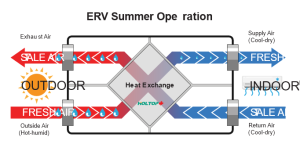 This smart design uses the outgoing air to help condition the fresh air coming in, so your heating and cooling system doesn’t have to work as hard. The result is a more comfortable space, fewer energy spikes, and a steady, balanced indoor climate all year long.
HRV vs ERV: What’s the Difference?
ERVs and HRVs both serve the purpose of ventilating indoor spaces by exhausting stale air and introducing fresh air. The key difference lies in how they manage moisture. HRVs transfer only heat between the incoming and outgoing air streams. This makes them more effective in colder, drier climates where retaining warmth is the primary goal and moisture control is less of a concern.
ERVs go a step further by transferring both heat and moisture. This feature is especially beneficial in moderate to humid climates like British Columbia. In the summer months, ERVs help stabilize indoor humidity by reclaiming moisture from the air before it exits the space.
By keeping indoor air from becoming overly dry, ERVs can help reduce dry skin, nasal irritation, and discomfort often caused by constant air exchange. They also contribute to a more balanced indoor environment, minimizing the impact of fluctuating outdoor conditions. In short, ERVs support healthier, more consistent air quality and comfort year-round.
Ductless ERVs Made Easy
Ductless ERVs provide a practical and efficient solution for achieving better indoor air quality, energy savings, and year-round comfort. Their compact, flexible design and easy installation make them a valuable addition to any modern space, especially in places where ducted systems are not ideal. As more projects prioritize livability, energy performance, and wellness, ductless ERVs are proving to be a forward-thinking choice.
To learn more, visit holtopcanada.com.