

BRIAN KINGZETT
CAMPBELL RIVER – A newly released report from the Canadian Aquaculture Industry Alliance (CAIA) reveals a growing imbalance in Canada’s food system. While demand for farm-raised salmon remains strong, production in British Columbia, which has traditionally led salmon production in Canada, has declined significantly, driving a surge in imports.
Since 2015, farm-raised salmon production in BC has fallen by more than 40 percent (Figure 1). Over the same period, Canada’s salmon imports have more than doubled (Figure 2), reaching approximately $700 million annually. Much of this growth has come from increased imports of salmon from countries such as Chile and Norway (Figure 3), as Canada turns to international suppliers to meet demand that could be fulfilled locally.
“Salmon remains Canada’s most consumed seafood,” said Brian Kingzett, Executive Director of the BC Salmon Farmers Association. “The data clearly shows demand is strong. With long-term regulatory certainty, Canada has a real opportunity to produce more of this food at home.”
Canadian-raised salmon is a climate-friendly source of protein and a significant contributor to the national economy. The BC sector currently supports more than 4,000 families and generates $1.2 billion in annual economic output, with the most significant impacts felt on Vancouver Island and in the Lower Mainland.
Increasing reliance on imported salmon also carries broader implications for food security, economic resilience, and climate policy, as imported salmon typically travels longer distances by ship or air, resulting in higher greenhouse gas emissions compared to locally produced Canadian salmon.
With renewed regulatory certainty and improved investment confidence, the sector has the potential to generate up to $2.5 billion in annual economic output and approximately 9,000 jobs by 2030, and as much as $4.2 billion in annual output and more than 16,000 jobs by 2040.
“With the right framework in place, BC salmon farmers are ready to support Canada’s food system and help build a stronger Canada,” said Kingzett.
FIGURES
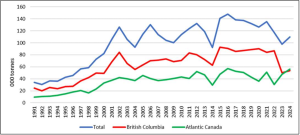
Figure 1. Production of farmed salmon by region, 1991 to 2024. Source: 2024 Aquaculture Industry Snapshot, Canadian Aquaculture Industry Alliance (CAIA), 2026. Data sourced from Statistics Canada. Table 32-10-0107-01.
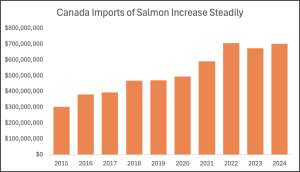
Figure 2. Value of Canada’s imports of salmon, 2015 to 2024. Source: Canadian Aquaculture Industry Alliance (CAIA). Data sourced from https://ised-isde.canada.ca/site/trade-data-online/en.
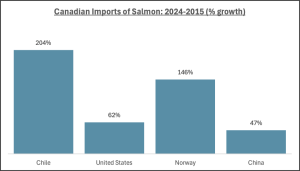
Figure 3. Percentage growth of Canadian imports of salmon from Chile, the United States, Norway and China, 2014 to 2015. Source: Canadian Aquaculture Industry Alliance (CAIA). Data sourced from https://ised-isde.canada.ca/site/trade-data-online/en.
For more information, visit bcsalmonfarmers.ca.