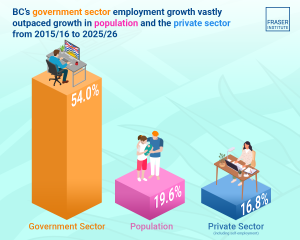
BRITISH COLUMBIA – The government sector in British Columbia grew by 54.0 per cent from 2015/16 to 2025/26, while population growth was only 19.6 per cent and private sector job growth (including self-employed) was 16.8 per cent over the same period, finds a new study published today by the Fraser Institute, an independent, nonpartisan Canadian public policy think-tank.
“Reining in BC’s government sector jobs so that levels reflect what they would have been if growth matched population growth or private sector job growth over the last 11 years could garner meaningful savings for the province,” said Tegan Hill, coauthor of Measuring Growth in BC’s Public Sector.
The study finds that from 2015/16 to 2025/26, the government added 153,604 fulltime equivalents (FTEs). FTEs are a measure of staff employment–two half-time employees equal one FTE, for example. Ultimately, taxpayers must pay for these additional government employees.
The Eby government plans to reduce the total government sector by 15,000 FTEs, which could generate roughly $1.9 billion in savings. In contrast, if total government sector FTEs were reduced to the level they would have reached had growth matched population growth or private sector job growth since 2015/16, potential savings would be $12.2 billion to $13.2 billion, respectively.
For perspective, B.C.’s projected budget deficit is $13.3 billion in 2026/27. “The Eby government’s current plan to rein in government jobs isn’t nearly enough to undo growth over the last 11 years.” Hill said. “Reducing levels to what they would have been under more sustainable growth would go much further in restoring fiscal stability in BC.”
By: Tegan Hill and Milagros Palacios